


PROPOSAL
The agri-food sector, and specifically the tomato industry, is under significant pressure from the energy prices required for its processes, in addition to the costs associated with CO2 emissions.
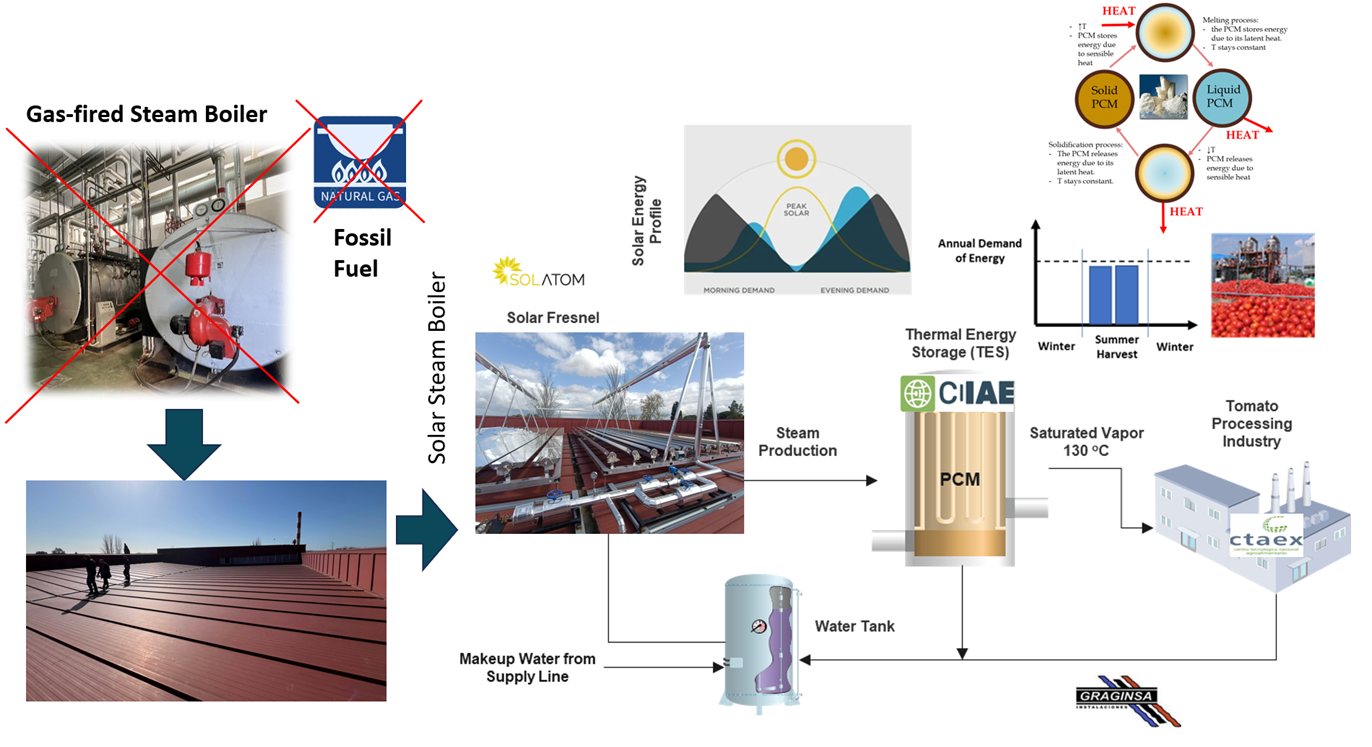
The STomSun project, “Research on Phase Change Materials for the Design of a Thermal Energy Storage System for the Tomato Industry,” approved under Decree 146/2022 of December 7, which establishes the regulatory framework for grants to finance industrial research and experimental development projects carried out in public-private partnerships by companies and public agents of the Extremadura science, technology, and innovation system, and approves the first call for projects related to energy storage, arises from the need to find an energy solution or alternative that allows the tomato industry to consume sustainable energy from a renewable and CO2-free source, thus reducing its dependence on natural gas. To this end, a thermal storage system will be investigated that allows the use of solar energy as a renewable energy source. Phase change materials (PCMs) best suited to the requirements of the tomato industry will be studied, taking into account its energy needs, consumption patterns, and operating conditions. A system for storing solar thermal energy using solar collectors will be designed, which will then be used to produce steam according to the industry’s demand.
The overall objective of the project is to investigate sustainable energy alternatives to reduce CO2 emissions and dependence on fossil fuels in the processing tomato sector. In this regard, the following specific scientific and technological objectives are proposed:
Replace the use of fossil fuels with green energy in the tomato industry, using solar thermal energy as an alternative source through solar collectors.
- Study and select optimal energy storage materials (MCPs) for the requirements of the tomato concentrate process.
- To design an efficient and sustainable thermal energy storage system.
- To investigate sustainable materials from agricultural waste for the thermal insulation of the energy storage system.
- To develop a demonstrator of the energy production and storage system for the process of tomato concentrate for industry on a laboratory scale.
The expected results are as follows:
- Reduction of the use of fossil fuels (natural gas) in the industrial tomato sector.
- Reduction of CO2 emissions produced during the industrial tomato concentrate process.
- Increased competitiveness of the tomato industry.
RESULTS
1.PCM Selection:
The search for potential PCMs in the literature and those commercially available was carried out with the requirement that the phase change temperature in the target range be 145 to 155ºC. After this selection, the following candidates were obtained:
After this, a preliminary selection was made, in which the following criteria have been used to make a first elimination of materials that are understood not to be selectable:
- A price per unit of mass that is too high.
- A flash temperature close to the working temperature.
- A high level of subcooling.
The remaining 4 candidates were subjected to multi-criteria decision-making. To do this, 5 parameters were weighted: latent heat, specific heat, thermal conductivity, density, energy price and hazardousness. Subsequently, a total of 58 algorithms were applied, each generating a ranking. It is concluded that adipic acid is the optimal PCM for this application, as it is the winning option in 47 out of 56 algorithms.

2.CFD Simulation:
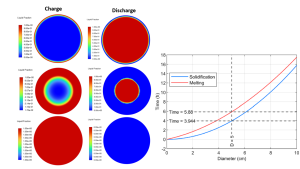
After knowing all the characteristics of adipic acid, the design of the storage system began. The first objective was to size the encapsulation of the storage system. To do this, computational fluid simulation was carried out with phase change in which different tube diameters were studied. To this end, 2D simulation of the capsule was carried out, putting the initial condition and boundary condition, 133 and 165 ºC, respectively, for charging, and 165 and 133 ºC for discharge. These temperatures allow heat exchange both in the loading and unloading phases, since the melting point of adipic acid is 150 ºC. It is concluded that the diameter that best suits this objective is 5 cm, as it allows charges and discharges that are adapted to the generation rhythms of solar thermal.
3.Design and construction of the thermal storage prototype
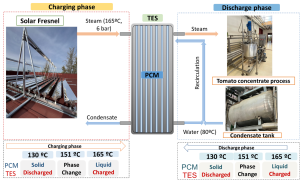
The storage system with phase change material has been integrated as with solar Fresnel energy. The system has two operating modes: charging and discharging.
In the charging phase, the initial condition of the PCM inside the macrocapsules is solid state, therefore, the TES system is discharged. During the day, the excess steam from the solar collector is introduced through the upper part of the TES at 165 °C. The energy from the steam is transmitted to the adipic acid capsules, causing the phase change of the latter from solid to liquid. With this transition, the energy is stored in the form of latent heat and the TES is in charged mode.
In the discharge phase, the initial condition of the PCM is a liquid state, so the TES system is charged. Now, during the hours of non-production of the solar collector, that is, during the night, water is introduced into the TES and recirculated. In this case, the PCM in a liquid state transmits its energy to said water, which causes it to turn into steam, which can be used directly in industry. In turn, the PCM inside the capsules, when releasing the energy, changes from a liquid to a solid state, and the TES system goes into discharged mode.
4.Publications and transfer
Articles
Title: Multiphysics modeling and economic design of a high-temperature phase-change-material thermal energy storage, for saturated steam generation industrial applications
Authors: Víctor Collar Serradilla; Ricardo Silva; Christopher Sathiya Satchi; Daniel López Pedrajas; Breogán Pato Doldán.
Journal: Applied Thermal Engineering (Elsevier)
DOI: https://doi.org/10.1016/j.applthermaleng.2025.127678
Publication date: 24/07/2025
Title: Assessment of renewable energy integration in the tomato concentrate production process.
Authors: Laura Moreno; Víctor Collar Serradilla; Rubén Sánchez; Ricardo Silva; Daniel López Pedrajas; Kashif Mushtaq; Christopher Sathiya Satchi; Breogán Pato Doldán; P. P. Andrada; B. Gallardo.
Journal: ISHS Acta Horticulturae
DOI: https://doi.org/10.17660/ActaHortic.2025.1445.18
Publication date: 12/2025
Title: Experimental study and long-term utilization validation of macro-encapsulated adipic acid as phase change material for industrial decarbonization
Authors: Víctor Collar Serradilla; Daniel López Pedrajas; Rahul Agrawal; Christopher Sathiya Satchi; Kashif Mushtaq; Breogán Pato Doldán.
Journal: In process of submission
DOI: In process of submission
Publication date: 2026/2027
Congresses
Title: Research on phase-change materials for the design of a solar thermal energy storage system for the tomato industry.
Authors: Rubén Sánchez; Laura Moreno; María del Carmen Carrillo; José Luis Llerena Ruiz; Breogán Pato Doldán; Daniel López Pedrajas; Kashif Mushtaq; Ricardo Silva; Christopher Sathiya Satchi; P. P. Andrada; Baltasar Gallardo.
Congress Name: 15th World Processing Tomato Congress and 17th International Symposium on Processing Tomato
City: Budapest (Hungary)
Type of contribution: Poster
Date: 12/06/2024
Title: Phase Change Materials (PCMs) selection methodology for application of solar process heat for tomato concentration industry in Extremadura Spain.
Authors: Victor Collar Serradilla; Daniel López Pedrajas; Kashif Mushtaq; Ricardo Silva; Breogán Pato Doldán.
Conference Name: ACS Fall 2024 Elevating Chemistry
City: Denver (Colorado)
Type of contribution: oral presentation
Date: 18/08/2024
Publication of the congress presentation: https://doi.org/10.1021/scimeetings.5c10747
Title: Macro-encapsulated adipic acid as phase change material for decarbonization of tomato industry
Authors: Victor Collar Serradilla; Daniel López Pedrajas; Rahul Agrawal; Breogán Pato Doldán; Kashif Mushtaq.
Congress Name: The World Energy Storage Conference 2025 (WESC-2025)
City: Istanbul (Turkey)
Type of contribution: oral presentation
Date: 09/12/2025
Publication of conference article: https://wesc-conference.org/wp-content/uploads/2026/01/Wesc_2025_Proceedings.pdf#page=80
Title: Proof of concept for decarbonization of the tomato concentrate industry
Authors: Víctor Collar, Daniel López, Rahul Agrawal , Christopher Sathiya, Kashif Mushtaq, Breogán Pato, Laura Moreno , Rubén Sánchez
Congress Name: 16th WPTC 2026. World Processing Tomato Congress. 18th ISHS Symposium on Processing Tomato.
City: Monterey, California USA
Type of contribution: Poster
Date: 7-10 June 2026
Industrial property
Title: Thermal Energy Storage and Steam Generation Equipment.
Authors: Kashif Mushtaq; Daniel López Pedrajas; Víctor Collar Serradilla; Rahul Agrawal; Christopher Sathiya Satchi; Breogán Pato Doldán;
Industrial Property: Utility Model
Entity: FUNDECYT Foundation Science and Technology Park of Extremadura-Iberian Center for Research in Energy Storage (CIIAE)
Application number: U202630193
Application date: 30/01/2026

